
SThree
SThree

When good work leaves room for more
Ask a recruitment company who its brand is for, and most will say the same thing: candidates.
Ask who its brand actually speaks to, and you will usually find someone else in the room: the client. They are the ones paying the fees, so quite reasonably, their priorities shape the language. Solving hiring challenges. Filling vacancies. Finding talent.
Candidates are the reason the business exists, yet inside most recruitment brands they become the product being moved rather than the audience being built for. Say the words "candidate-first" in a pitch and nobody will disagree with you.
The difficult part isn't deciding who the brand is for. It's understanding what that decision actually demands.
I joined SThree, a global specialist STEM talent recruiter during a major rebrand already underway. A strategic platform had been developed, a new identity was taking shape, and the business had committed real time and investment to redefining how it showed up in the market. My job was to help bring that strategy to life globally.
As with any engagement, I started with a reality check: understanding the direction of the brand, the market it competed in, and whether the decisions being made were building the company SThree actually wanted to become.
What I found wasn't weak thinking. SThree wanted to become the number one destination for STEM talent, with candidates at the heart of the business. That ambition was already reflected in its purpose: bringing skilled people together to build the future. It was a direction the business genuinely believed in.
The opportunity wasn't changing the strategy. It was pushing it further.
The work wasn't creating a different ambition. It was making sure every subsequent decision reinforced it.
What candidate-first actually means
Recruitment companies naturally organise people by role, discipline and seniority. It's an effective way to structure vacancies and navigate a complex market, but it rarely aligns with how specialists define their own professional identity.
Ask a STEM specialist who they are and they rarely start with a generic job title. They'll tell you what they're trying to solve: the disease they are working to cure, the clean energy grid they are trying to scale, or the architecture they are trying to build.
They care about their craft, the problems they're solving and the impact their work has on the world. People like that don't recognise themselves in rigid, transactional categories.
If SThree wanted to become the genuine home for STEM talent, the brand had to anchor itself to the ambitions of the people it was trying to attract. That's where candidate-first stopped being an abstract statement of intent and became a strategic choice.
The promise Elevate expertise. Energise progress. moved the conversation away from standard recruitment language towards specialists fulfilling their potential. Messaging that had previously spoken about candidates started speaking to them directly:
"You can do things others can't. We find you opportunities others won't."
"Spark new possibilities. Supercharge your potential."
"Your career. Unboxed."
Once the brand aligned with what motivated these specialists rather than how the industry categorised them, every subsequent brand decision flowed from that understanding.

Candidates are the reason the business exists, yet inside most recruitment brands they become the product being moved rather than the audience being built for.
Visualising the shift
SThree's ambition was to help STEM specialists seize their moment. That ambition needed to be reflected across the entire identity system, particularly through photography. If the brand was genuinely built around candidates, then they had to become the defining expression of the brand.
Recruitment photography has its own predictable, stock-image shorthand. Look at almost any competitor's website, or SThree's own existing imagery, and you see the same world: perfectly staged meeting rooms, identical smiling suits, people laughing unnaturally at clipboards. If the brand existed to champion STEM specialists, why would its visual world still borrow the clichés of the recruitment industry?
So we moved away from it entirely. Instead, we created a brand world that was bold, expressive, and energetic, designed to put candidates and their craft at the absolute centre. Content photography did something quieter but just as deliberate, working across three distinct angles: the STEM specialist, their unique skills, and the broad impact their work can have on the world. This was who the brand was actually built for.

The new brand world: candidates and their craft at the centre, not the process of being hired.
Candidate-first stopped being an abstract statement of intent and became a strategic choice.
Built to travel
A distinctive brand is only half the job. It has to work for the people running it, everywhere it operates.
SThree operates across multiple countries, each with its own market and communication needs. A global campaign, a thought leadership piece, an internal deck and a local recruitment advert all ask something different of the core assets.
Before this work, consistency had been enforced rather than designed for, and those aren't the same thing. Assets were approved centrally, and consistency came to mean looking identical, regardless of what a market actually needed. Markets that couldn't get what they needed through that process defaulted to the safest option available: generic stock photography, the very clichés we were trying to leave behind.
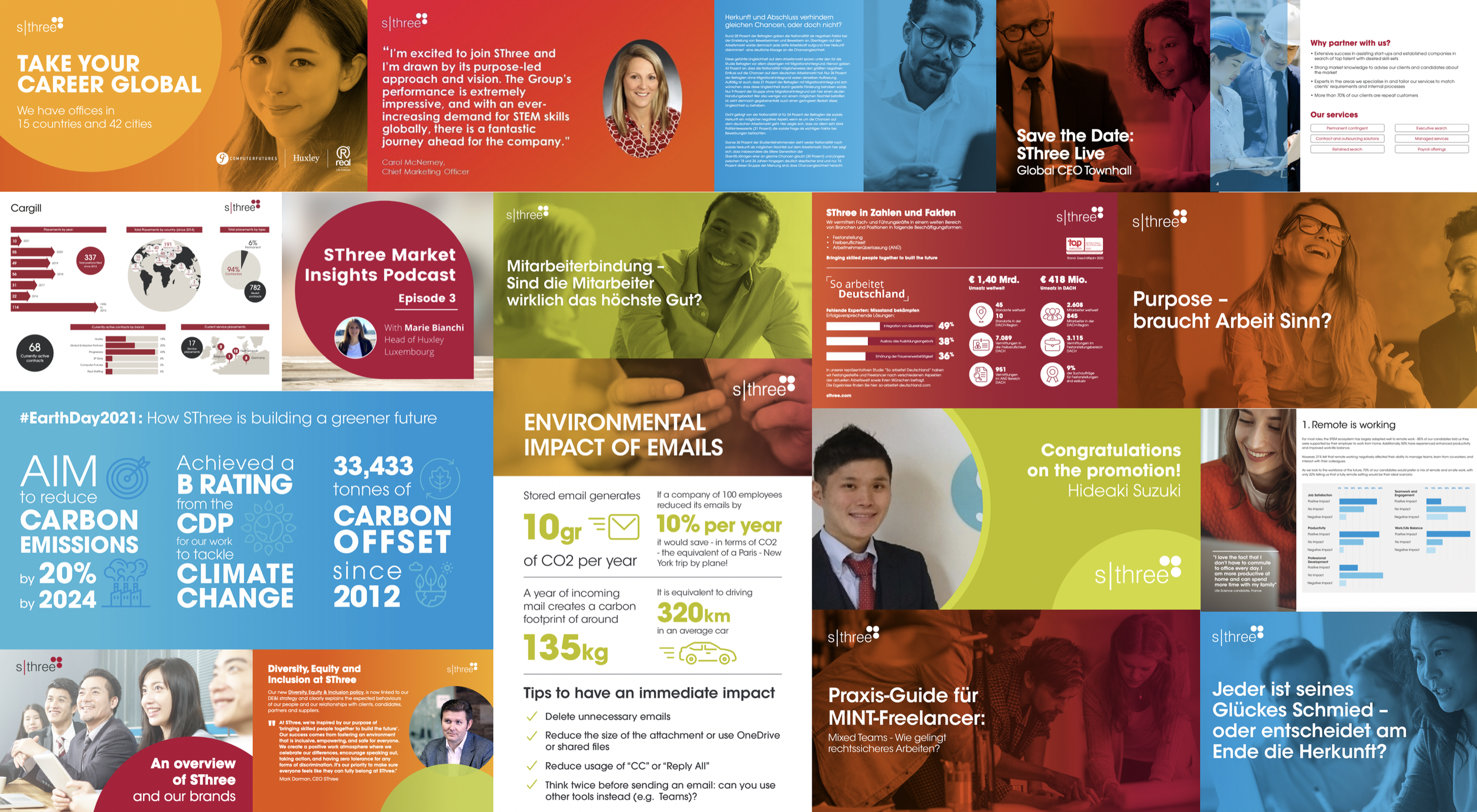
Consistency was a shared idea, not a shared look.
